Short answer
Swirl marks are thousands of fine scratches in your clear coat, and they’re almost always inflicted during cleaning, not by the road. Tunnel-wash brushes carry grit from every car ahead of yours. The damage is cumulative and it’s permanent until someone machine-polishes it out. Correction works because clear coat is thick enough to level, but you only get to do that a limited number of times over a car’s life.
Why your car looks worse in the sun than in the garage
Almost every car we’re asked to look at in Cobb County arrives with the same complaint, phrased the same way: it looks fine until the sun hits it.
What you’re seeing is a spiderweb of very fine scratches in the clear coat. Under diffuse light they’re invisible, because there’s no single bright source for them to scatter. Put a point source on them, whether direct sun, a streetlight in a parking deck at The Battery or headlights behind you, and every one of those scratches throws light back at a different angle. The result is that halo of swirls radiating out from the bright spot.
Dark cars show it worst. Not because they scratch more easily, but because there’s no colour contrast to hide the white light being scattered. A silver car with identical damage looks fine.
Where swirl marks actually come from
This is the part that surprises people. Road debris causes chips and the occasional deep scratch. It doesn’t cause swirls. Swirls come from contact during cleaning, in roughly this order of severity:
- Friction tunnel washes. Those spinning cloth or foam strips touch every car that goes through. They pick up sand, brake dust and clay from the vehicle in front of you and carry it straight onto your paint at speed. The brush isn’t the problem; what the brush is holding is.
- Unlimited memberships. The mechanism isn’t different, but the frequency is. Four passes a month for two years is roughly a hundred abrasive events. This is the single most common cause of heavy swirling we see in Cobb.
- Dry wiping. Pollen in March, dust off a construction lot, a quick swipe before a meeting. All of it’s grinding grit across clear coat.
- One bucket and an old towel. Washing at home with a single bucket means every dip returns the grit you just removed back to the mitt.
- Bad drying. A stiff or contaminated drying towel dragged across a dry panel. Half the swirls on well-cared-for cars are inflicted in the last five minutes of the wash.
Is a touchless wash safe?
Safer, and a reasonable compromise. Nothing physically touches the paint, so nothing drags grit across it. The trade-off is chemistry: touchless systems have to use aggressive detergents to compensate, and heavy repeated use strips wax and sealant quickly and can dull trim over time.
Our honest ranking for a car you care about: proper hand wash, then touchless, then friction tunnel, then dry-wiping it yourself. If a membership is what fits your life, get a touchless one and keep a real layer of protection on the car.
What paint correction actually is
Correction isn’t a product you apply. It’s controlled removal.
Your paint is layered: primer, then base coat (the colour), then clear coat on top, typically somewhere around 40 to 50 microns of clear on a modern factory finish, which is thinner than a sheet of paper. Swirls are valleys cut into that clear layer. Because you can’t fill a valley permanently, the only real fix is to lower the surrounding surface until the valley is gone.
That’s what a machine polisher and an abrasive compound do: remove a few microns of clear coat, uniformly, until the scratches are no longer there. Then a finer polish refines the finish to full gloss.
| Enhancement / one-step | A single polishing stage. Removes light swirls and restores most of the gloss. The best value for a daily driver. |
|---|---|
| Two-stage correction | A cutting stage followed by a refining stage. Removes the large majority of defects. This is what most people mean by “paint correction”. |
| Multi-stage | For heavily damaged or show-standard finishes. Slow, careful, and priced accordingly. |
| What it can’t fix | Anything through the clear into the base coat. If you can catch a fingernail in a scratch, or it shows colour, polishing won’t remove it. |
The part nobody tells you: clear coat is finite
Every correction spends some of it. A careful one-step might take two or three microns; an aggressive multi-stage takes more. You have a limited budget over the life of the car, and once the clear is too thin it fails. It goes cloudy, then it peels, and at that point the only repair is repainting the panel.
This is why we’ll sometimes tell a customer their car does not need correction, and why any detailer who wants to compound your paint every year is doing you harm. The correct sequence is to correct once, properly, then protect it and change how the car is washed so you never need to correct it again.
How to keep it after you have paid for it
Correction without a change in habits is money set on fire. Three things preserve the result:
- Put a coating or sealant on immediately. Freshly polished paint is completely bare. It also gives you a sacrificial layer, so light marring lands on the coating instead of the clear coat.
- Stop using friction washes. This is non-negotiable if you want the finish to last. Hand wash, two buckets, clean media, or have someone do it properly.
- Fix the drying. Clean plush towels, a drying aid, and never a dry pass on a dry panel.
We do paint correction for a lot of cars in Smyrna, Vinings, Acworth and around the Town Center area, and the ones that still look right two years later are the ones where the owner changed the wash routine. Every time.
We work at your home or your office, anywhere in Cobb
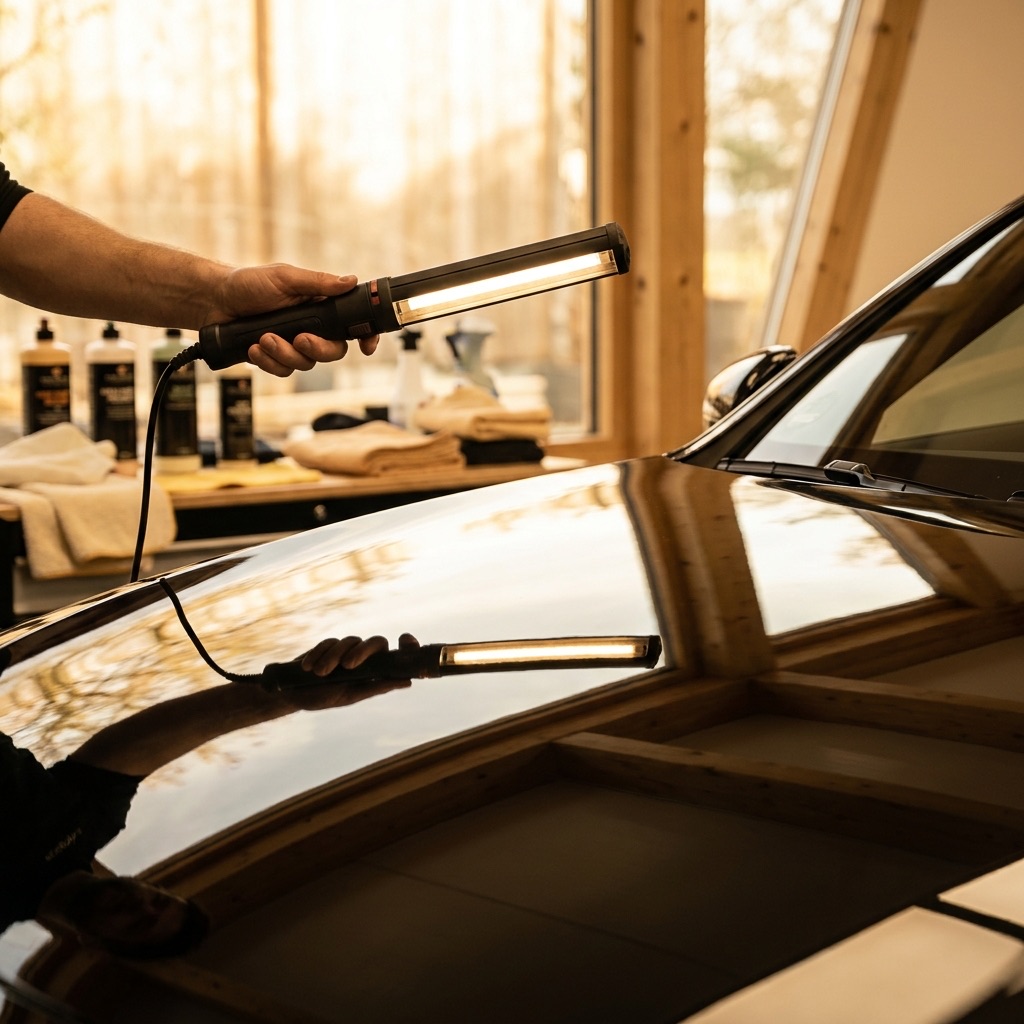
Correction is an unhurried job, and being mobile means it happens in your driveway rather than costing you a day at a shop. We arrive with our own water, power and lighting. Proper inspection lighting matters more than people realise, because you can’t correct what you can’t see.